Geoff Perry
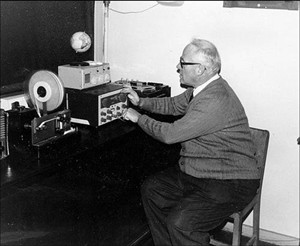
Geoff Perry with his receiver
Copyright Sven Grahn 1979
The Satellite Hunters of K.G.S.
In October 1966 the eyes of the world became focused briefly on Kettering Grammar School.
This was due to the activities of the science teacher, Geoff Perry, who, with the help of antiquated equipment and a team of enthusiastic pupils, managed to unlock the secrets of the Soviet Russian space programme even before the Americans.
Extraordinarily, this was not the only time he achieved such a feat. From the early 1960's, Perry had realised that by studying the Doppler Effect - marked by a change in the signal as the spacecraft passed overhead - he could discover the orbit of the Soviet Cosmos satellites.
Starved of equipment - at first he was obliged to use the computer at the corset factory in Desborough - he relied on close monitoring and improvisation (his receiver needed "a smart tap with the hand from time to time"). His breakthrough came with the launch of Cosmos 112, in May 1966, which alerted him to something strange about the Soviet space effort. The satellite did not seem to have come from the usual site at Baikonur in Khazakstan. The launch of Cosmos 129 in October of that year from the same unknown site enabled him to pinpoint it.
The new site was identified as Plesetsk, south of Archangel. The USSR did not admit to its existence for a further 17 years. That same year he enjoyed another scoop when he became the first scientist to announce the launch of an unmanned Russian Soyuz spacecraft.
Perry's life changed as the world's media descended upon him. His name was often in the newspapers as he teased out one secret after another about the Soviet space programme. He realised the significance of the varying signals transmitted by satellites and was able to identify which were on short missions and which were up for longer. He even managed to track the signals monitoring the cosmonauts' vital functions from one of the first manned Soyuz craft. He inspired a growing band of space trackers among his pupils who named themselves the Kettering Satellite Group.
In the 1970's, he became space consultant to Independent Television News, commenting on the Apollo moonshots and the Apollo-Soyuz link-up in 1975. He retired from teaching in 1984, and died in 2000.